Learning Outcomes:
i. Recall the definition of a chiral center and the concept of chirality in organic molecules.
ii. Recognize and identify chiral centers in structural formulas of organic compounds.
iii. Apply the concept of chirality to distinguish between chiral and achiral molecules.
iv. Analyze the presence of chiral centers in various classes of organic compounds, including alkanes, alkenes, and alkynes.
v. Appreciate the importance of identifying chiral centers for understanding the stereochemistry of organic molecules.
Introduction
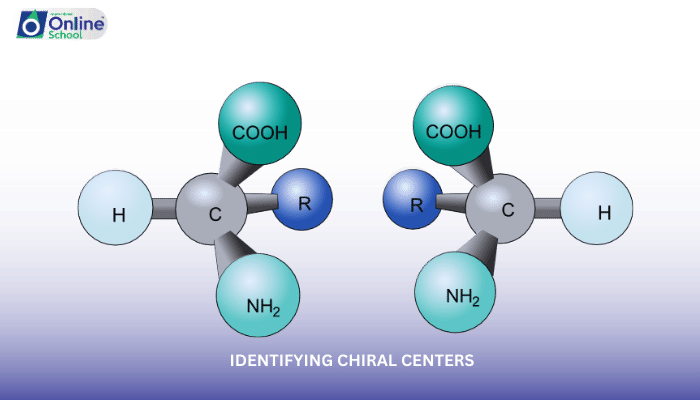
In the realm of organic chemistry, chirality plays a crucial role in determining the three-dimensional arrangement of atoms and the properties of molecules. Building upon our understanding of chiral centers and optical isomerism, this lesson focuses on identifying chiral centers in structural formulas of organic compounds.
i. Identifying Chiral Centers: A Step-by-Step Approach
Determine the Tetrahedral Nature of the Carbon Atom: Identify carbon atoms in the molecule. For a carbon atom to be chiral, it must have four different substituents attached to it.
Exclude Identical Substituents: Discard any substituents that are identical, such as two methyl groups or two chlorines.
Check for Hydrogen as a Substituent: If hydrogen is one of the substituents, it is considered different from any other group.
Chiral Center Presence: If the remaining substituents are all different, the carbon atom is considered a chiral center.
Examples of Chiral and Achiral Molecules
Chiral Molecules:
- 2-bromopropane (CH3CHBrCH3)
- Lactic acid (CH3CHOHCOOH)
Achiral Molecules:
- Methane (CH4)
- Ethane (C2H6)
- 2-chloropropane (CH3CH2ClCH3)
ii. Chirality in Alkanes, Alkenes, and Alkynes
Alkanes: Chiral centers can occur in branched alkanes, but not in straight-chain alkanes.
Alkenes: Alkenes with at least two different substituents on each carbon of the double bond have a chiral center.
Alkynes: Terminal alkynes cannot have chiral centers, but internal alkynes can be chiral if both carbons of the triple bond have different substituents.
iii. Significance of Identifying Chiral Centers
Identifying chiral centers is essential for understanding the stereochemistry of organic molecules. Chiral molecules can exist as enantiomers, which have different biological and pharmacological properties. The ability to distinguish between enantiomers is crucial in drug development and other fields that rely on the specific properties of chiral molecules.
Identifying chiral centers in structural formulas is a fundamental skill in organic chemistry. By understanding the concept of chirality, analyzing substituents, and applying the step-by-step approach, students can effectively determine the chirality of organic molecules and appreciate the significance of chiral centers in various fields.
